
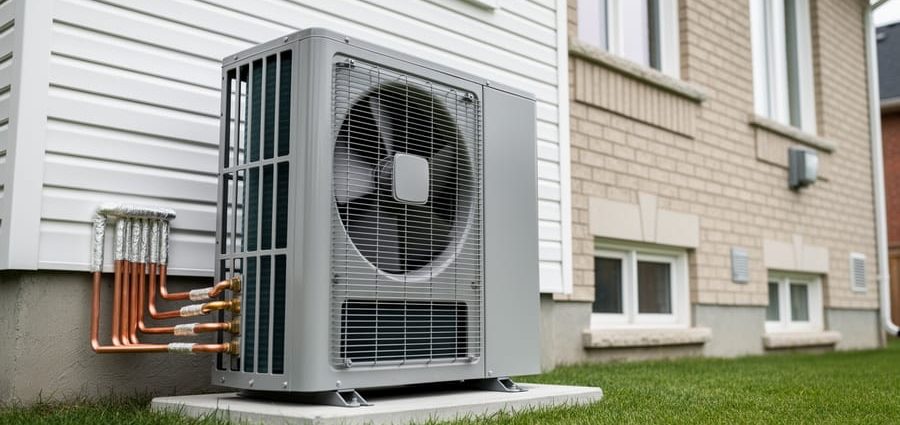
A 2 ton heat pump installation in Toronto typically costs between $5,500 and $9,000 in 2026, with most homeowners paying around $7,200 for a complete professional setup. This price covers the unit itself, labor, permits, and essential components like refrigerant lines and electrical upgrades. A 2 ton system is designed to heat and cool spaces between 1,000 and 1,200 square feet, making it ideal for smaller homes, condos, or well-insulated bungalows across the GTA.
The final price depends heavily on four variables: the brand and efficiency rating of the heat pump, whether your existing ductwork needs modification, electrical panel capacity, and the complexity of the installation site. High-efficiency models with SEER2 ratings above 16 push costs toward the upper end but qualify for larger rebates through programs like the Canada Greener Homes Grant. Meanwhile, older homes without updated electrical service often require a panel upgrade, adding $1,500 to $3,000 to the project.
Toronto contractors report that supply chain improvements have stabilized equipment costs compared to previous years, but labor rates remain firm due to strong demand for heat pump conversions. Residents switching from gas furnaces or replacing aging air conditioning systems find that rebates and long-term energy savings make the upfront investment more manageable than expected.
2 Ton Heat Pump Installation Costs by System Type
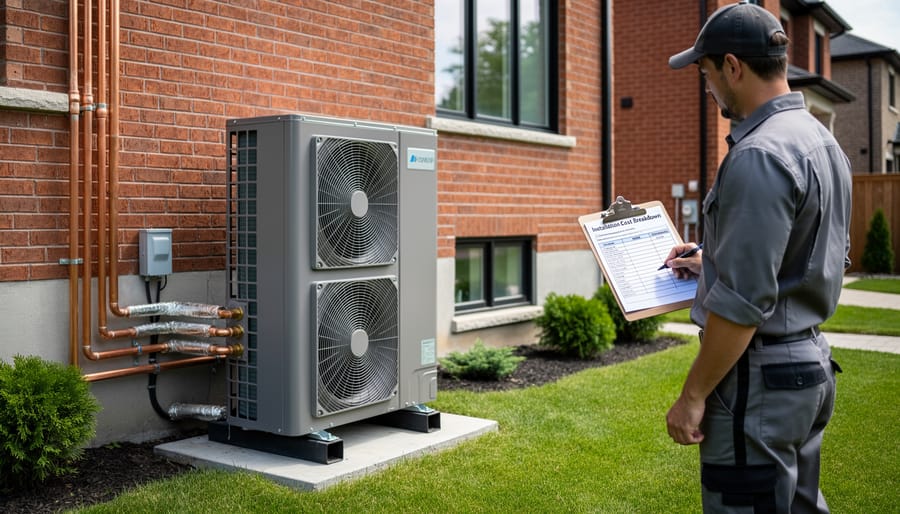
The type of 2 ton heat pump you choose drives your bottom-line cost more than almost any other factor. Toronto homeowners can pick from three main configurations, each suited to different homes and budgets.
Air-Source Heat Pumps (Ducted Central Systems)
If your home already has ductwork, a ducted air-source heat pump slots into your existing system. Expect to pay $7,000 to $12,000 installed in Toronto. Higher-end models with better cold-climate performance push toward the upper range. These systems heat your whole house through your existing vents, making them ideal for detached homes and larger townhouses where duct runs already exist.
Ductless Mini-Split Systems
Ductless mini-splits cost $6,500 to $10,000 for a 2 ton system in Toronto. They work well in homes without ductwork, older houses where adding ducts isn’t practical, and condos where space is tight. A single outdoor unit connects to two or three indoor wall-mounted heads, giving you zone control. Installation takes less time since contractors don’t need to modify ductwork, but you’ll see the indoor units mounted on your walls.
Ground-Source (Geothermal) Heat Pumps
Ground-source systems start around $15,000 for a 2 ton unit and climb past $25,000 depending on your property. The equipment itself costs more, and installation requires drilling boreholes or trenching your yard to bury ground loops. Most Toronto homeowners skip this option for a 2 ton system because the capacity is small relative to the excavation investment, but it delivers the lowest operating costs if you’re heating a smaller, well-insulated home long-term.
| System Type | Typical Cost Range | Best For | Installation Complexity |
|---|---|---|---|
| Ducted Air-Source | $7,000, $12,000 | Homes with existing ductwork, detached houses | Moderate |
| Ductless Mini-Split | $6,500, $10,000 | Condos, older homes, no ductwork | Low to Moderate |
| Ground-Source (Geothermal) | $15,000, $25,000+ | Long-term investment, well-insulated smaller homes | High |
Ductless mini-splits give Toronto homeowners the lowest entry price and fastest installation, typically one to two days. Ducted systems take longer if your contractor needs to seal leaky ducts or add returns, pushing the timeline to three or four days. Ground-source installations stretch over a week or more because of the excavation work.
Your existing infrastructure matters. A home with functional, sealed ductwork keeps costs at the lower end for ducted systems. Homes needing new duct runs, electrical panel upgrades, or extensive modifications will hit the higher end of these ranges or exceed them.
What’s Included: 2 Ton Heat Pump Installation Cost Breakdown
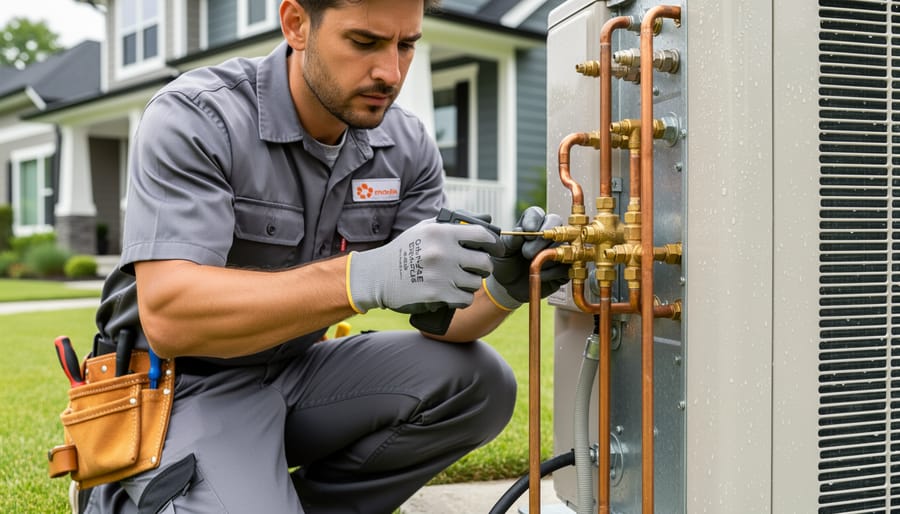
When you receive a quote for 2 ton heat pump installation, understanding what you’re actually paying for helps you evaluate whether the price is fair and complete. Here’s where your investment breaks down.
Equipment costs typically represent the largest single expense, ranging from $3,000 to $6,500 for the heat pump unit itself. This includes the outdoor condenser, indoor air handler (for ducted systems) or wall-mounted units (for ductless), and the manufacturer’s standard warranty. Higher-efficiency models with better SEER2 and HSPF2 ratings sit at the top of this range, while basic contractor-grade units occupy the lower end.
Labour and installation fees account for $1,800 to $3,500 of your total cost. This covers the technician’s time to position equipment, connect refrigerant lines, test system performance, and ensure everything operates safely. Complex installations, like working in tight crawl spaces or installing units on upper floors, push labour costs higher.
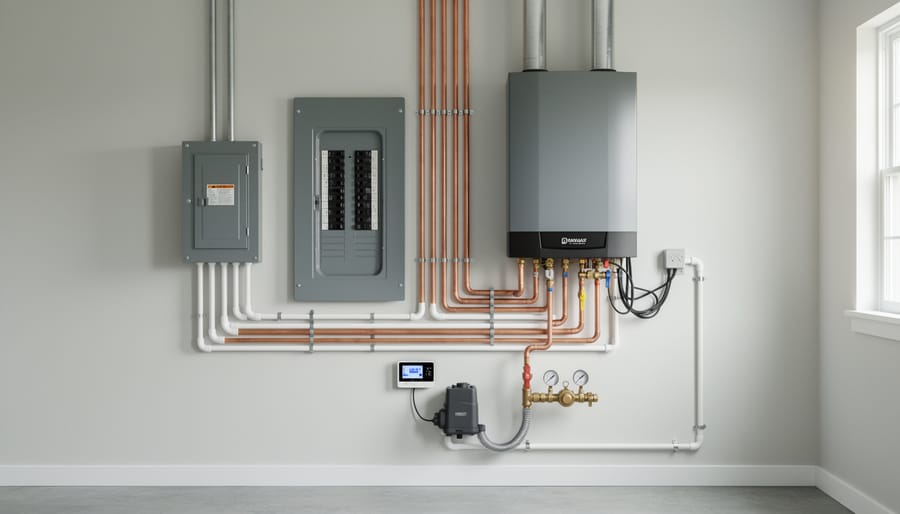
Electrical work adds $400 to $1,200, depending on your home’s current setup. Most 2 ton heat pumps require a dedicated 240-volt circuit. If your electrical panel has available capacity and is located near the installation site, you’ll pay less. Homes needing panel upgrades or extensive wiring runs face steeper electrical bills.
Permits and inspections in Toronto typically cost $150 to $400. Your contractor should handle permit applications, but verify this is included in your quote rather than presented as a surprise add-on.
Ductwork modificationsif needed, range from $500 to $2,000. Many Toronto homes already have forced-air systems, but older ductwork may need sealing, insulation, or minor extensions to optimize heat pump performance. Ductless systems skip this cost entirely.
Here’s what these components typically look like in a complete quote:
- Heat pump equipment: $3,000, $6,500
- Labour and installation: $1,800, $3,500
- Electrical work: $400, $1,200
- Permits and inspections: $150, $400
- Ductwork modifications: $0, $2,000 (if required)
- Thermostat and controls: $150, $500
- Line set and refrigerant: $200, $600
- Condensate pump (if needed): $150, $350
Additional components round out the package. A programmable or smart thermostat costs $150 to $500, while the refrigerant line set (the copper tubing connecting indoor and outdoor units) runs $200 to $600 depending on the distance between components. Some installations require a condensate pump to drain moisture, adding another $150 to $350.
When comparing quotes, look for itemized breakdowns like this. Contractors who provide vague “all-in” prices without explaining individual costs make it harder to spot what’s missing or where you might negotiate.
Factors That Affect Your 2 Ton Heat Pump Installation Price
Toronto-Specific Cost Considerations
Toronto’s unique characteristics create cost pressures beyond the national average. Winter design temperatures regularly hit -20°C, pushing installers toward cold-climate heat pumps with enhanced vapor injection or two-stage compressors, expect to pay $800, $1,500 more than standard models rated for milder climates. This isn’t optional marketing; units without proper cold-weather capability struggle below -15°C and force expensive auxiliary heat reliance.
Municipal permit fees in Toronto run $150, $300 for HVAC work, plus separate electrical permits if your panel needs upgrading to handle the heat pump load. Processing times stretch two to four weeks during peak seasons, delaying projects and potentially increasing labour costs if contractors need multiple site visits.
The city’s housing stock complicates installations. Pre-1960s homes often lack proper insulation and may require ductwork retrofits, adding $2,000, $5,000. Narrow lot infill houses challenge outdoor unit placement, sometimes requiring custom bracket mounting or sound attenuation to meet setback bylaws. Condos face strata approval processes and structural limitations on rooftop or balcony installations; some buildings prohibit exterior modifications entirely, forcing ductless mini-splits as the only viable option.
Installer availability varies sharply by season. June through September books solid, with wait times exceeding eight weeks and premium pricing common. February and March offer better rates and faster scheduling, though extreme cold can pause outdoor work temporarily.
Toronto Heat Pump Rebates and Incentives for 2026
Toronto residents installing a 2 ton heat pump in 2026 can tap into several rebate programs that significantly reduce upfront costs, often by $3,000 to $6,000 when stacked strategically.
The Canada Greener Homes Grant remains the largest federal incentive, offering up to $5,000 for qualifying air-source heat pump installations. To qualify, your system must meet minimum efficiency standards (typically 15 SEER2 or higher), and you’ll need pre- and post-installation EnergyGuide evaluations by a certified energy advisor. These evaluations cost roughly $600 combined, but they’re required to unlock the grant and may reveal other upgrade opportunities.
Enbridge Gas rebates are available through their Home Efficiency Rebate Plus program for Toronto customers who currently heat with natural gas. The rebate amount depends on your system’s efficiency rating and can reach $5,800 for high-efficiency models, though it requires switching away from gas heating entirely. You must apply before installation and receive pre-approval, retrofitting after the fact won’t qualify.
The City of Toronto currently doesn’t offer heat pump-specific rebates, but homeowners may access funding through the Home Energy Loan Program (HELP)which provides interest-free financing for energy upgrades. This pairs well with rebates to cover remaining costs without draining savings.
- Check your eligibility for federal and provincial programs based on your current heating system and home type.
- Book a pre-installation energy assessment through a registered service organization, don’t skip this step, as it validates your baseline for grant applications.
- Submit rebate applications before purchasing equipment or starting work, especially for Enbridge programs that require pre-approval.
- Choose equipment that meets or exceeds minimum efficiency thresholds (verify SEER2/HSPF2 ratings with your contractor).
- Complete installation with a licensed contractor who provides detailed invoices and product specifications, you’ll need these for claims.
- Arrange your post-installation energy assessment within the program’s timeline (usually six months).
- Submit final claims with all required documentation: invoices, assessment reports, proof of payment, and equipment specifications.
Processing times vary, but most homeowners receive federal grant payments within eight to twelve weeks after submitting complete documentation. Enbridge rebates typically arrive faster, often within four to six weeks. One Toronto homeowner in Leslieville combined the federal grant with Enbridge rebates to cut her $9,200 installation down to $3,400 out-of-pocket, proof that doing the paperwork pays off.
Program details and funding levels shift periodically, so verify current offerings and deadlines directly with each program before committing to installation.
DIY vs. Professional Installation: What You Need to Know
Installing a 2 ton heat pump yourself might seem like an obvious way to save money, equipment costs the same whether you install it or hire someone. But in Ontario, attempting a DIY heat pump installation quickly runs into legal, technical, and financial walls that erase most savings and create serious risks.
Homeowners can legally handle certain preliminary tasks: clearing the installation area, running a dedicated electrical circuit to the disconnect box (if you’re comfortable with basic electrical work and pull the proper permit), and preparing the outdoor pad. That’s where your DIY involvement should stop. The refrigerant handling, pressure testing, vacuum evacuation, and final connections require a licensed HVAC technician holding valid TSSA (Technical Standards and Safety Authority) certification in Ontario. It’s not just best practice, it’s the law.
Hiring an unlicensed friend or attempting the refrigerant work yourself voids your manufacturer’s warranty immediately. Most heat pump warranties explicitly require professional installation by certified technicians, and they verify this when you register the equipment. One improper refrigerant charge can reduce efficiency by 20% or more, costing you hundreds annually in wasted energy while shortening the system’s lifespan.
Pros of DIY
- Save $2,000-$4,000 in labour costs if you can legally complete the work.
- Control the timeline and work at your own pace.
- Learn your system intimately for future maintenance.
Cons of DIY
- Voids manufacturer warranty and potential insurance claims.
- Refrigerant handling requires TSSA certification, illegal without it.
- Improper installation reduces efficiency and lifespan significantly.
- Safety risks include electrical shock, refrigerant exposure, and structural damage.
- No recourse if something goes wrong or the system underperforms.
The realistic middle ground: hire a licensed professional for the technical installation, but negotiate to handle site prep, pad installation, and minor finish work yourself. Some contractors will reduce their quote by $300-$600 if you’ve already prepared the site properly. You get professional expertise where it matters, maintain your warranty, ensure the system runs efficiently, and still trim some cost. For a $10,000 installation that will heat and cool your home for 15-20 years, paying for proper installation isn’t an expense, it’s insurance against expensive mistakes.
Finding the Right Installer in Toronto
Finding a qualified installer is just as important as choosing the right heat pump. A skilled contractor ensures proper sizing, efficient installation, and long-term performance, while a poor installation can void warranties and lead to expensive repairs.
Start by getting at least three written quotes. Detailed estimates should itemize equipment, labour, permits, electrical work, and any ductwork modifications. Vague quotes that lump everything into one number make it impossible to compare value or spot hidden costs.
Verify credentials before signing anything. In Ontario, heat pump installers need TSSA (Technical Standards and Safety Authority) certification. Ask for their TSSA license number and confirm it’s current. Check that they carry WSIB coverage and liability insurance, at minimum $2 million. A legitimate contractor provides proof without hesitation.
Don’t skip references. Ask for contact information from three recent Toronto installations, preferably homes similar to yours. When you call, ask about punctuality, cleanliness, how they handled unexpected issues, and whether the system performs as promised.
Examine warranty coverage closely. Reputable installers offer labour warranties (typically 1-5 years) separate from manufacturer equipment warranties (5-12 years). Understand what each covers and who handles service calls if problems arise.
Watch for red flags: pressure to sign immediately, requests for full payment upfront, no physical business address, or prices significantly lower than competitors. Toronto homeowner Michelle Chen learned this the hard way: “We went with the cheapest quote and regretted it. They rushed the installation, didn’t pull permits, and disappeared when we had issues.” She ended up paying another contractor to fix the work.
Take time to choose carefully. The lowest price rarely delivers the best value.
Frequently Asked Questions
How long does a 2 ton heat pump installation take?
Most installations take one to three days, depending on whether ductwork modifications are needed. A straightforward replacement in a home with existing ducts typically completes in a single day, while new ductless mini-split systems or installations requiring electrical upgrades may extend to two or three days.
Will a 2 ton heat pump work during Toronto winters?
Modern cold-climate heat pumps operate efficiently down to -25°C or lower, making them viable for Toronto’s winter temperatures. Most homeowners keep their existing furnace as backup for extreme cold snaps, creating a dual-fuel system that maximizes efficiency year-round.
How much can I save on energy bills with a 2 ton heat pump?
Toronto homeowners typically see 30-50% reductions in heating costs compared to electric baseboard or oil furnaces, and 20-30% savings versus natural gas when the heat pump handles the majority of heating. Actual savings depend on your current system, insulation quality, and electricity rates versus gas prices in your area.
What size home does a 2 ton heat pump heat?
A 2 ton unit generally suits homes between 1,000 and 1,400 square feet, though the exact capacity needed varies with insulation levels, window quality, ceiling height, and your home’s layout. An HVAC contractor should perform a Manual J heat load calculation rather than relying solely on square footage.
When is the best time to install a heat pump in Toronto?
Spring and fall offer the best pricing and availability, as contractors face lower demand than during summer cooling season or winter heating emergencies. Installing during shoulder seasons also gives you time to test the system before extreme temperatures hit.
Do I need to replace my furnace when installing a heat pump?
No. Many Toronto homeowners keep their existing furnace and run the heat pump as the primary heating source, with the furnace kicking in only during the coldest days or as backup, which extends the furnace’s lifespan while maximizing energy efficiency.
Beyond these common questions, timing your installation strategically can affect both cost and comfort. Contractors often run promotions during slower months, and you’ll have more flexibility to schedule around your availability rather than waiting weeks for an opening. Getting quotes in early spring also means you can take advantage of any newly announced rebate programs before funding runs out later in the year.
If you’re replacing an older system, ask contractors whether your existing thermostat, electrical panel, and refrigerant lines can be reused. Homes built or updated within the past decade often have compatible infrastructure that reduces installation costs. Conversely, houses with outdated wiring or undersized electrical service may need panel upgrades that add $1,500 to $3,000 to the total project cost.
Installing a 2 ton heat pump in Toronto represents a significant upfront investment, typically ranging from $6,500 to $12,000 depending on your system type, home configuration, and chosen equipment. While that price tag might seem steep, it’s crucial to view this as a long-term investment rather than a simple expense.
The total cost drops considerably when you factor in available rebates and incentives. Between federal programs like the Canada Greener Homes Grant and provincial Enbridge rebates, Toronto homeowners can recover $2,000 to $5,000 or more. That brings your actual out-of-pocket cost down to a much more manageable range, often under $8,000 for a quality system.
Beyond the initial savings, a properly installed heat pump delivers ongoing benefits. Lower monthly energy bills, improved home comfort year-round, and reduced environmental impact all contribute to the return on your investment. Most homeowners see payback within 5 to 10 years through energy savings alone.
The key to maximizing value lies in choosing a qualified installer who understands Toronto’s climate demands and your specific home needs. Don’t settle for the first quote you receive. Get at least three estimates from licensed contractors, verify their credentials, and ask detailed questions about equipment specifications and warranty coverage.
Take the time to explore every available rebate program before you commit. That extra research effort translates directly into money saved and ensures you’re making the smartest financial decision for your home’s heating and cooling future.